 |
|
|
|
|
|
|
|
|
|
|
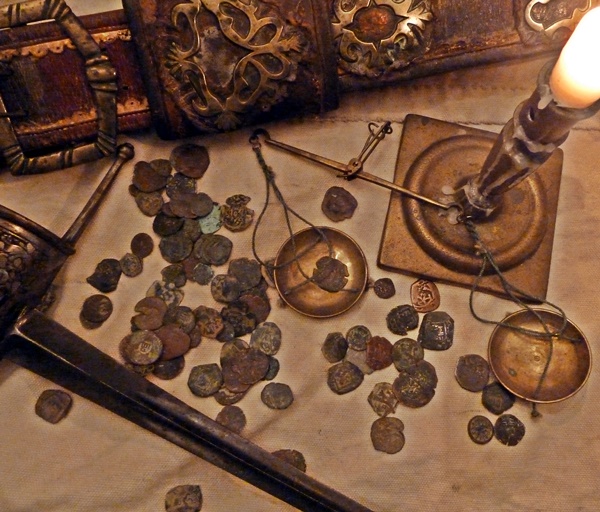 |
SMALL SPANISH COBS
This is the small change from the Great Age of Piracy, the beer money of their time. These little coins are irregular in shape and were usually not made on a circular coin press. They were hand cut from copper plugs and stamped with the seal usually indicating the value of the coin and the reigning sovereign of the time. Some were over-stamped at a later date and revalued. These are generally in two to eight maravedi denominations and date from the reign of Carlos I (Charles I), 1526-1556, up to Carlos III, 1759-1788. Found in tavern and village sites, they're genuine and 250 to 450 years old.
|
Our Price:
5 for $20.00
E-Mail
Inquiries
Call for
More Info:
207.657.2117
|
|
|
|
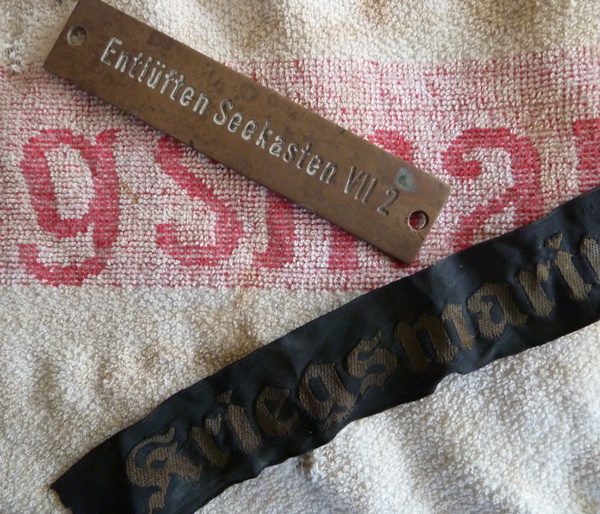 |
LOT OF U-BOAT SOUVENIRS
Here is an odd assortment of items taken from a German submarine at the end of World War II. Not many of these warships survived the war so items taken from these subs have become very collectible.
This lot includes a spec plate marked �Enluften Seekasten VII 2� which translates as Ventilator Chest VII 2. The vent system on U Boats was vital for the crew's survival when submerged. My friend Rudy served in the Kriegsmarine u-boat fleet during the war and said that poor ventilation during prolonged periods under water was one of the frights of service in �unterseeboots.� Included with this lot is a Kriegsmarine cap tally that has been cut short, and a well-used Navy hand towel complete with original grease and grime stains from its service. It's rough but rare. You will be the only one on your block to own one.
|
Our Price:
SOLD
E-Mail
Inquiries
Call for
More Info:
207.657.2117
|
|
|
|
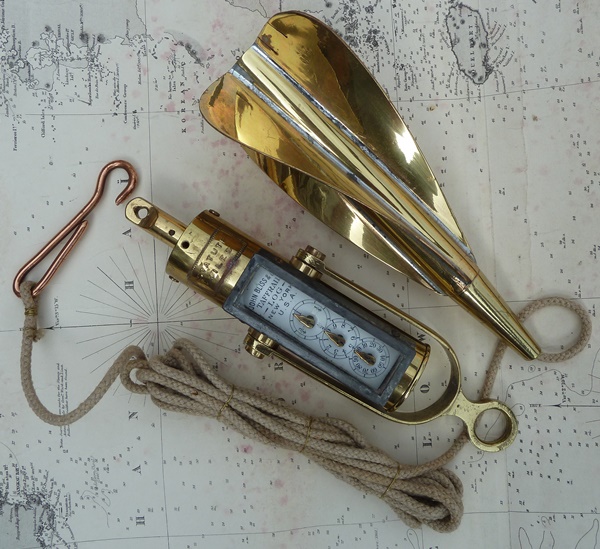 |
OLD YACHT TAFFRAIL LOG
In beautiful condition, this is an early taffrail log made by the famous firm of John Bliss and Co. of New York, probably around the turn of the 20th century. It includes the original meter and the rotator, also called a fish, that would be towed astern. This unit came from an old collection and has been cleaned and buffed to a high luster.
|
Our Price:
SOLD
E-Mail
Inquiries
Call for
More Info:
207.657.2117
|
|
|
|
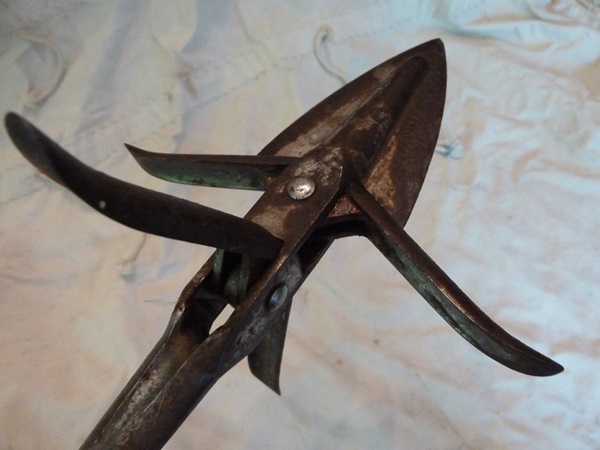 |
FOLDING BARB HARPOON
You could collect the variations in whaling and fishing harpoons for years and never cease to be surprised at the odd types that appear in the strangest places. This lethal-looking example showed up at a small gun show here in Maine.
An unusual tool, it was probably used for catching large fish and small whales. It has a broad blade head accompanied by four powerful barbs. They're made to unfold after striking the creature, holding him securely. The steel blade is still sharp.
At one time, this harpoon was tin-plated to retard rust and corrosion. Some of that tin, now turned gray, is still evident. Tin was often used in marine equipment before the widespread use of chrome. The shaft is steel, hollow on the end to accept a fitting. The whole unit is 23 inches long.
Click on photo to see multiple images. (#12234)
|
Our Price:
SOLD
E-Mail
Inquiries
Call for
More Info:
207.657.2117
|
|
|
|
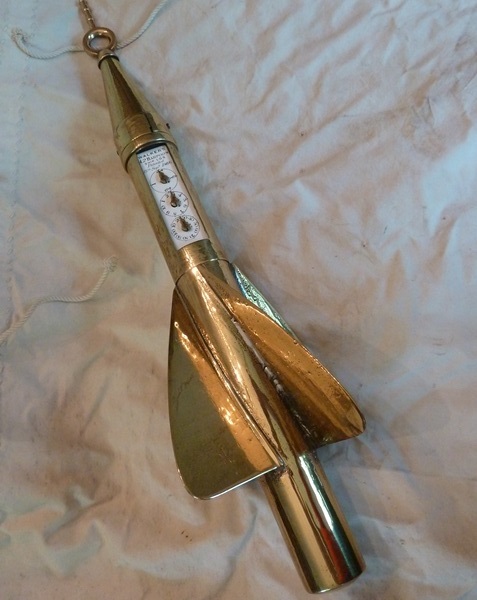 |
EARLY WALKER HARPOON LOG
Thomas Walker developed the harpoon log in the 1860s so mariners could figure out the speed and distance they had traveled over a specific time period. This became the modern technological successor to the chip log which had been used for centuries.
This particular instrument was made between 1866 and 1875. It measures 20 inches long and has an enameled dial that is protected by a rolling brass cover.
Can you spot the flaw in the design? It would be obvious to experienced mariners. The spinning brass "fish" shape would attract large fish and sharks, who would gobble the instrument resulting in the loss of the entire unit. Later designs used stiff line and a separate dial or meter on the stern rail of the ship. Rotors were easily replaced if lost.
You can allow it to mellow over the years. This is a great, not to mention rare instrument.
Click on photo to see multiple images. (#12335)
|
Our Price:
SOLD
E-Mail
Inquiries
Call for
More Info:
207.657.2117
|
|
|
|
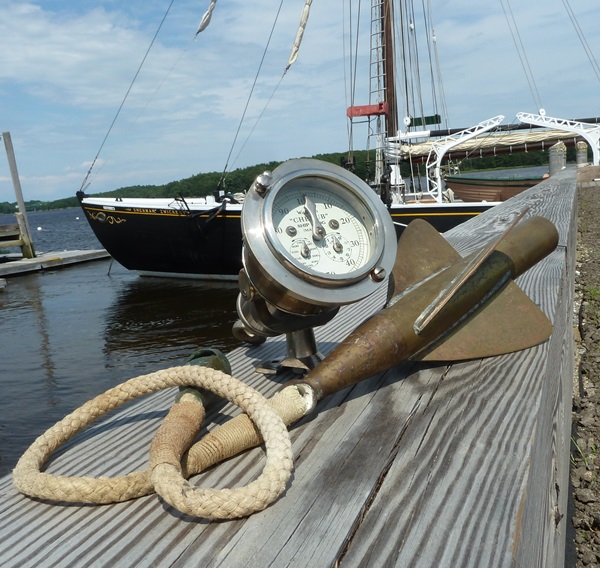 |
WALKER "CHERUB" LOG
Here is an original meter and matching rotor. These are good examples of deep sea instruments once commonly used aboard large sail and steam ships. While not often used anymore, they make wonderful display items for collectors. And I occasionally sell a set to a mariner who appreciates the old, traditional ways.
This style of taffrail log was designed in 1878 by Thomas F. Walker, Jr., the son of the original founder of the Walker Company. The original design incorporated a single unit that was towed behind the ship to determine speed and distance. This new design separated the log meter (dial) which was attached to the stern rail from the "fish" or rotator which was towed in the sea. It was much easier and cheaper to replace the rotator than the whole unit.
Click on photo to see multiple images. (#12338)
|
Our Price:
SOLD
E-Mail
Inquiries
Call for
More Info:
207.657.2117
|
|
|
|
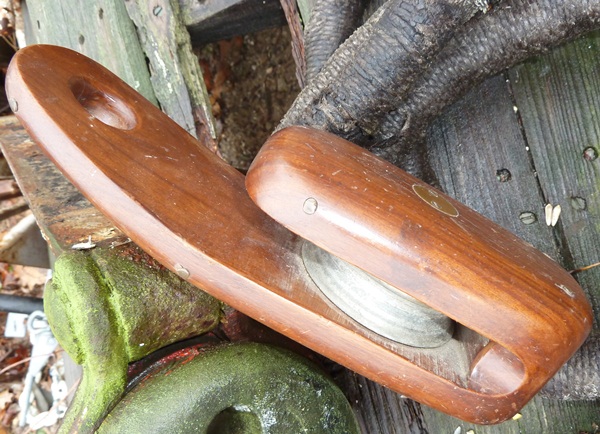 |
UNUSUAL SNATCH BLOCK
Riggers don't come across many of these. This is a snatch block made of a single piece of hardwood for a shell. It carries a three-inch bronze sheave, one-inch wide, securely pinned through both cheeks. There is a 7/8th inch hole in the top of the shell for a lanyard. Small bronze pins are run through the wood to reenforce the wood and prevent checking. The block is 10 inches long and three inches deep. Handy for quick use in hauling, and as a fairlead. Give it a try on your next rig overhaul. (12184)
|
Our Price:
$125.00
E-Mail
Inquiries
Call for
More Info:
207.657.2117
|
|
|
|
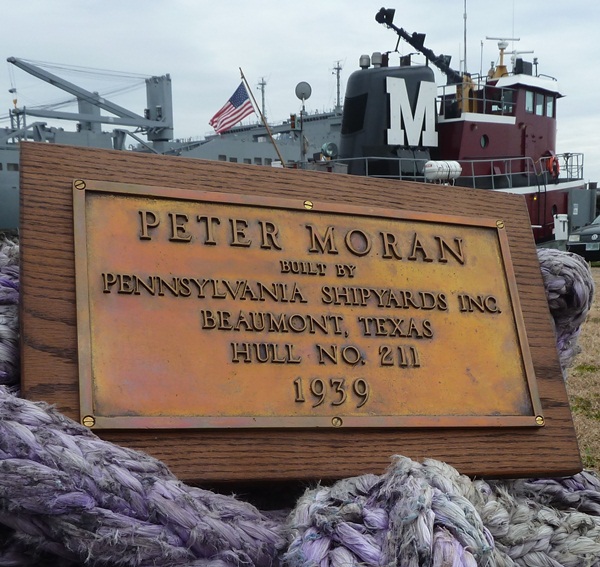 |
TUG PETER MORAN BUILDERS PLATE
The Peter Moran was built in 1939 by Pennsylvania Shipyards in Beaumont, Texas for the Moran Tug Company. When war came to Europe the US Navy knew it was only a matter of time before the US would be involved, so they began acquiring tugs for the emergency, including the Peter Moran. It was converted for naval use at the New York Navy Yard in November,1940, renamed Donacona.
In May of 1942 she was YNT-7, then reclassed as YTM-733 in August 1945. After the war,the tug returned to civilian service as the Peter Moran until being sold and renamed Sagamore in 1948. She later sailed as the Buck Allen and the Charlie Mentz. She was scrapped in New Orleans in 1983. She measured 93 by 22 by 10.75 feet and weighed in at 137 g.t. Moran Towing replaced her in 1941 with a new Peter Moran.
This is the original builders plate for the first Peter Moran. It is heavily cast in solid bronze and measures 16.5 by 8.5 inches (42 by 22 cm). It is mounted on a 18 by 20 inch oak plaque and weighs close to 18 pounds. (12181)
|
Our Price:
SOLD
E-Mail
Inquiries
Call for
More Info:
207.657.2117
|
|
|
|
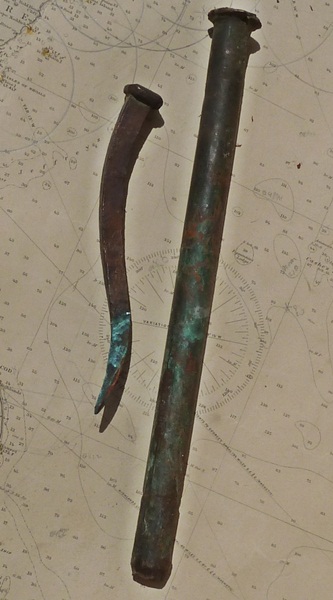 |
BRONZE SPIKE & DRIFT PIN FROM USS NEW HA
Construction on the ship that would become the USS New Hampshire began in 1819 at the Portsmouth Navy Yard in Kittery, Maine. At the time, the 74-gun, ship-of-the-line was named Alabama. However, due to political and architectural issues, construction halted and the incomplete ship remained in stocks for 40 years.
Launched as the New Hampshire in 1864, listed as 2600 gross tons and 196.3 feet long, the ship served as a hospital and supply vessel off the Carolina coast in the final months of the Civil War. While under tow off the New England coast in 1922, the old ship caught fire under mysterious circumstances. She sank off of Grave's Island, Massachusetts, where divers still occasionally pay her a visit.
Here is a bronze spike, one of her original fastenings, well-marked with a reversed "US." It is in excellent condition considering what it has been through. It is about 7 inches long with a half-inch shank. I have not disturbed the old finish but it would shine up nicely. This spike was recovered by a diver many years ago.
The drift pin, used to fasten major timbers and planking, is 11.5 inches long with a 3/4 inch shank. It is unmarked and shows only slight corrosion. Choose the one you like best, only $75. Or take both for $125.00.
|
Our Price:
Drift Pin Available
$75.00
E-Mail
Inquiries
Call for
More Info:
207.657.2117
|
|
|
|
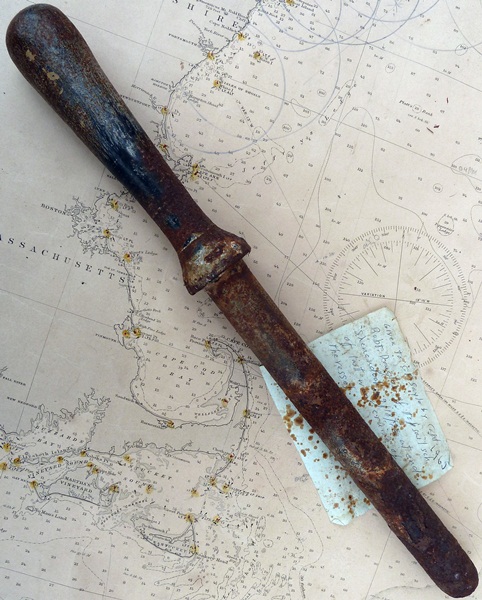 |
CHARLIE SAYLE'S BELAYING PIN
I remember my dad standing on the Main Street Pier, Nantucket, smoking his pipe and swapping sea stories with Charlie Sayle. Charlie arrived on Nantucket around 1927 and never left. He knew the island and its history better than any academic scholar. My dad would take summers off from deep sea shipping to sail as chief engineer on excursion ships so our family could be together. I shipped out as "ship's boy," or apprentice, at $3.00 a week. Charlie was one of the benefits of the Nantucket run. He has been gone for years but his legend remains.
A friend came up with this iron pin recently. A piece of paper wrapped around the shaft says "Given to C.F. Sayle by Capt. Robt. Douglas of topsail schooner Shenendoah 9/18/70 at end of last week's cruise of the vessel." All written in the hand of Charlie himself. Capt. Bob Douglas is a famous island figure in his own right. I haven't checked with him about the belaying pin's origins but it is obviously much, much older than Shenendoah, which was built in Maine in the 1960s.
This is a heavy iron belaying pin, 15.5 inches long, with about a one-inch shank. A great souvenir of old Nantucket.
|
Our Price:
SOLD
E-Mail
Inquiries
Call for
More Info:
207.657.2117
|
|
|
|
|
|
|
|
|
|

|
|
At China Sea Marine Trading our focus is Nautical Antiques, Tools & Traditions. Expect the usual, and the unusual. Explore the categories from bells to binnacles, ship's lights to swords, ship's wheels to ring buoys, net floats to flags to folk art, telescopes to tribal art. Find an ocean liner menu for your collection, a fid for your ditty bag. Chart a course with a compass or choose an artifact from the Great Age of Piracy. And if you don't see what you want, ask for it.
Your inquiries are welcome! |
|
|
|
China Sea Marine Trading Co.
Steve Bunker & Sharon Bondroff
229 Portland Road • Gray, Maine 04039
Phone: 207-657-2117
E-Mail: [email protected]
©2008 China Sea Trading. All rights reserved.
|
|
|
|
|
|
|
|
|
|
|
