 |
|
|
|
|
|
|
|
|
|
|
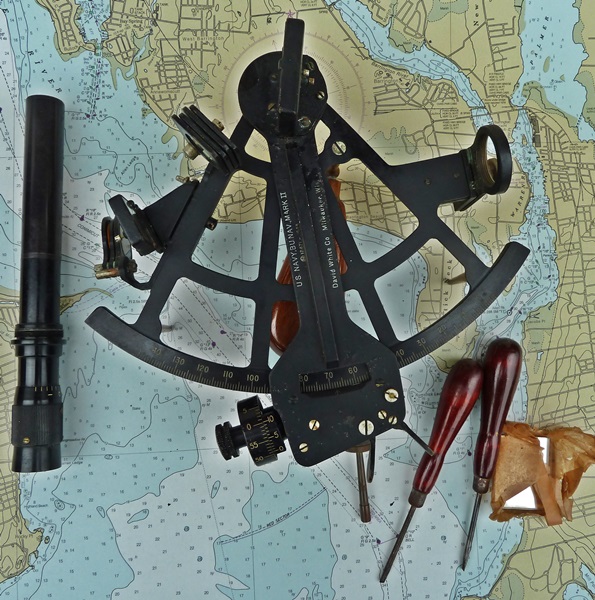 |
US NAVY MARK II SEXTANT+D4
Probably more mariners have learned celestial navigation with the Mark II than with any other sextant. The Navy contracted with several firms during WW II to produce this compact, uncomplicated design.
The David White Co. of Milwaukee made this one in 1943. It has seen good sea time and could use a little cleaning, but should prove serviceable. It has the micrometer drum for fine readings and two sets of sun filters. It comes with a scope, two screwdrivers for adjustments and an extra index mirror. If you any questions, let me know.
Click on photo to see multiple images. (#12350)
|
Our Price:
SOLD
E-Mail
Inquiries
Call for
More Info:
207.657.2117
|
|
|
|
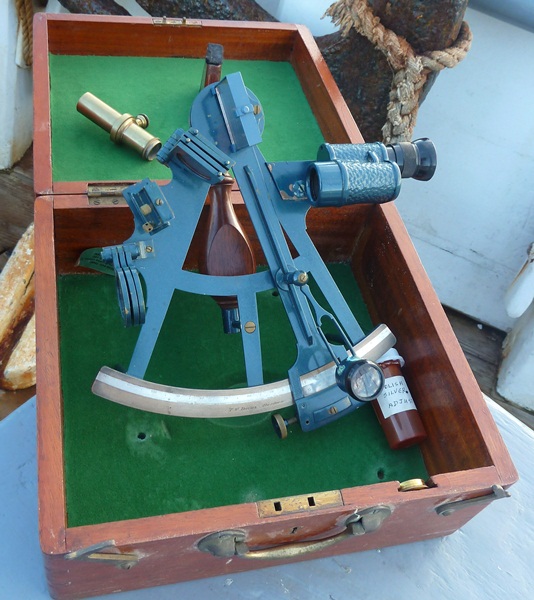 |
DAVIES OCTANT
Occasionally an old instrument will be reconditioned and updated by someone who just can't part with his favorite piece. Here is such an instrument.
This is a traditional mid-19th century-style bronze frame octant. It has a silver inlaid bronze arc marked from zero to 120 degrees. The arc is hand-engraved T.W. Davies, Aberdeen. At some point in recent years, it was disassembled and overhauled. New index and horizon mirrors were installed. The magnifier for the arc was upgraded. A new 6 x 22 monocular was adapted to replace the old sighting tube. The frame was repainted to retard verdigris and corrosion. The mahogany case was refinished and relined. It came with a pill bottle holding a small polishing cloth and an adjustable wrench. A great old piece of navigation history which can still do the job. Fine for noon sights or as an instructional tool.
When I was a boy, these instruments were often referred to as "fisherman's octants." Back then you could still find them on occasion on the North Sea trawlers out of Scotland and Atlantic Canada.
|
Our Price:
$400.00
E-Mail
Inquiries
Call for
More Info:
207.657.2117
|
|
|
|
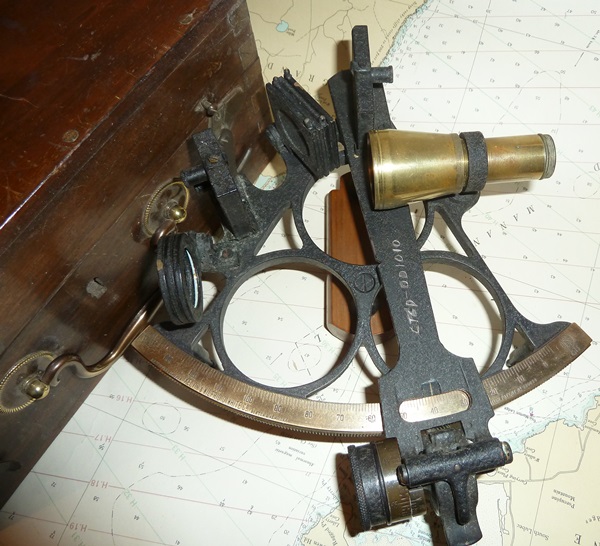 |
KELVIN & WILFRED WHITE SEXTANT
Nothing fancy, just a good, reliable British-made sextant, probably manufactured before World War II for use in the merchant service. Old salts will remember the White business on the Boston waterfront. In fact, they are still there. This instrument spent some years as an instructional tool and its certification card has been lost, but with a check-up and adjustment I'm sure it can go back to work. It has been much handled but not abused. It has a bronze frame with its original black finish and a micrometer drum. As with all British-made instruments, it is solidly built for years of service. It comes in a nice, traditional, dove-tailed box.
|
Our Price:
SOLD
E-Mail
Inquiries
Call for
More Info:
207.657.2117
|
|
|
|
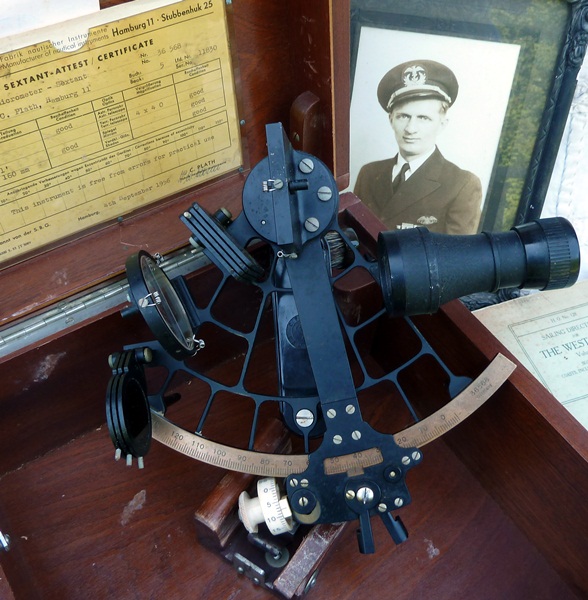 |
CAPT. JOHANSSONS PLATH SEXTANT
It is always nice when acquiring a used sextant to know its history. This one was made by Cassen Plath of Hamburg in 1956. Plath has long been considered the premier maker of sextants. It was bought by Capt. Arthur J. Johansson, veteran master mariner and captain of many American, deepwater ships in war and peace.
He acquired the instrument from Iver Weilback in Copenhagen and it accompanied him around the world. Capt. Johansson was a legend in his own time who served on Liberty ships on the Murmansk Run during World War II as well as on U.S. Lines and Moore MacCormack ships through the 1960s. He was known as "the old Viking" and was a stern taskmaster of the old school. The photo shown was taken aboard the S.S. Mormacpenn in Stockholm harbor in 1962.
This Plath micrometer drum sextant has a 4 by 40 scope. The arc is graduated from -5 degrees to +125 degrees. It weighs 5 lbs, 12 ounces. It comes with its adjustment key, brush, inspection certificate and mahogany carrying case. Also included-- some miscellaneous notes and a great photo of Capt. Johansson (see photo number 4.
Considering its history and the scarcity of good, serviceable Plath sextants, I think you will find this instrument quite reasonably priced.
|
Our Price:
SOLD
E-Mail
Inquiries
Call for
More Info:
207.657.2117
|
|
|
|
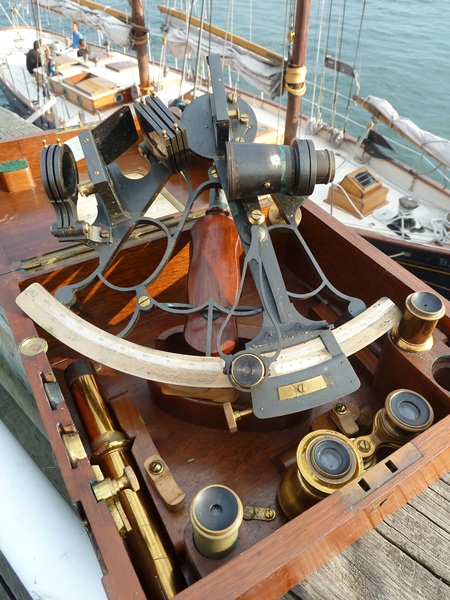 |
HEATH OR F. SMITH SEXTANT
In its day, this was the Rolls Royce of marine sextants, made by the famous firm of Heath & Co. for F. Smith & Son, Southhampton. This is the classic bell frame Mark II sextant that became popular with professional mariners in the 19th and early 20th century. This is a higher grade instrument with five tubes and optics, filters and accessories. It is numbered 8883 and bears its national physical laboratory certificate dated December 1909. It has a silver vernier divided in 10". The arc is hand-engraved "Heath & Co. Ltd. Crayford, London Made For F. Smith & Son Opticians, Southhampton."
The instrument locks in place in its case with the Heath patent button lock. The mahagony case has a couple of minor blemishes and age scuffs from over 100 years of hard work but is in otherwise excellent condition. It still bears its original ivory spec plate. The sextant and accessories retain nearly all of their original finish. Examine the photos. This is a beautiful instrument.
|
Our Price:
SOLD
E-Mail
Inquiries
Call for
More Info:
207.657.2117
|
|
|
|
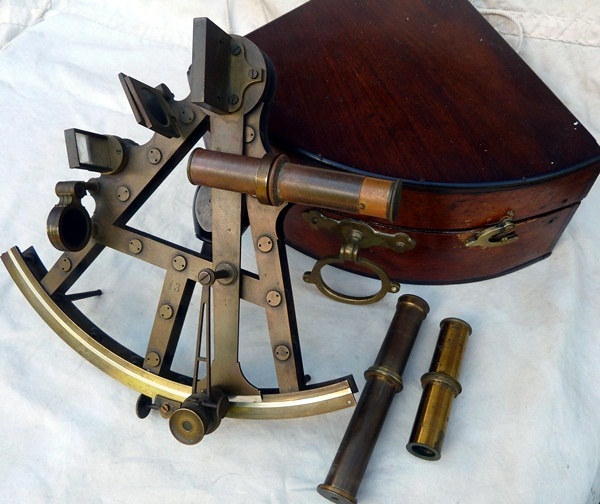 |
UNUSUAL PILLAR FRAME SEXTANT
Here is a landmark in the history of the marine sextant.
Early mariners, beginning in the mid-18th century, relied on the wood-framed octant for celestial navigation. This was found to be insufficient for lunar observations. By the 1780s most ocean mariners kept an octant for daily meridians and a sextant for lunar distances after dusk. With technological improvements in manufacture it was now possible to produce an instrument smaller in size and weight, and with a more accurate machined arc. Bronze became the preferred material for sextants, being more rigid and stable than wood or brass. In an effort to lighten the bronze frame, Jesse Ramsden produced a lightweight double frame instrument in brass that we now call a "pillar" sextant because of the method of joining the two frames. These sextants were produced by Ramsden and later in the early 1800s by Troughton and Simms, but on a fairly limited basis. They were expensive and never gained the popularity of the more common single, cast-framed instruments.
Here is a rare version of the pillar framed sextant. It is framed with 1mm thick sheet brass with a reenforced arc inlaid with platinum, marked to 140 degrees. The brass is hand-engraved "Prof. Smiths Etablm. Kjobenhavn No. 185." On the "T" brace of the top frame is engraved the numeral 13. The instrument is accompanied by two scopes and a tube sight, all engraved with the same "13." The case bears the label of J.E.A. Hansen of Copenhagen. Hansen represented the Smith firm in Denmark. The Danish maritime museum has a lattice frame sextant with similar markings, and sold by Hansen, in its collection.
The keystone style case has quite unique hardware as you can see in our photos. Though well used, the sextant is in good, functional condition. I have given the instrument a light cleaning with a dry cloth (never shine a sextant). If you would like more photos, please call us at 207 657-2117.
|
Our Price:
SOLD
E-Mail
Inquiries
Call for
More Info:
207.657.2117
|
|
|
|
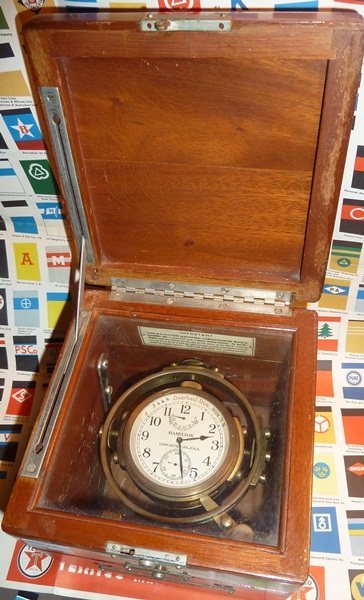 |
HAMILTON DECK WATCH MODEL 22
This chronometer watch was made by Hamilton during WWII for use by US Navy navigators. They proved to be very accurate, plus more compact and rugged than the Model 21. Mariners and collectors appreciated the slightly reduced size and ease of winding and setting.
This deck watch is designed to run for 48 hours on a winding. It has been stored away for many years. A small sticker says it is due for overhaul in November of 1972. Still, it runs fine and has kept good time for me over the last few days.
The wood case is in excellent condition and would grace any coffee table or display. (1000-5)
|
Our Price:
SOLD
E-Mail
Inquiries
Call for
More Info:
207.657.2117
|
|
|
|
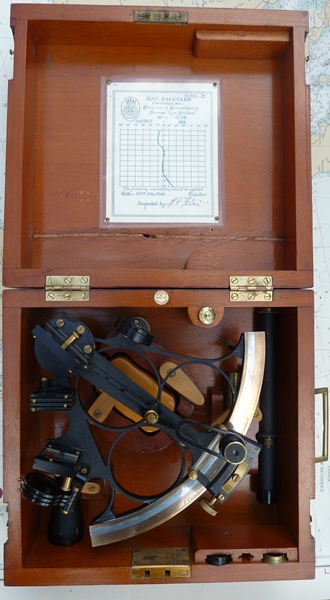 |
J. COOMBES SEXTANT
This is a fine example of an antique sextant that has found new life. This instrument was made over 100 years ago by Coombes in Devonport, England. It was a top quality, bronze frame instrument made for W.A. Palmer whose name was hand-engraved on the lower index arm. At some time in its history, the sextant became property of the Canadian Navy, probably as a result of World War I or II. In 1958, it was completely reconditioned at the Naval Dockyard at Esquimalt, British Columbia. Even the finish on the frame and scopes was redone, and the original box was refinished and the sextant was given a new serviceability certificate.
It's hard to believe that it is 100 years old. It can go to sea today. But be aware of the drawbacks of even this fine example of navigator's art. It has an engraved silver arc which is hard for older eyes to read. It has no illumination unit, unlike many more modern sextants, which makes it less convenient for star sights. It has smaller optics and no micrometer drum, both features of later instruments. That being said, I still have my old Stackpole sextant made for the U.S. Navy in 1862 and I wouldn't part with it. It has been relegated to backup status, behind my Plath Navistar Classic, but I still love the down-to-basics feel of my old bronze frame antique.
This is a great instrument and a wonderful piece of history. Exadmine the pictures. Feel free to call with questions. (1000-4)
|
Our Price:
SOLD
E-Mail
Inquiries
Call for
More Info:
207.657.2117
|
|
|
|
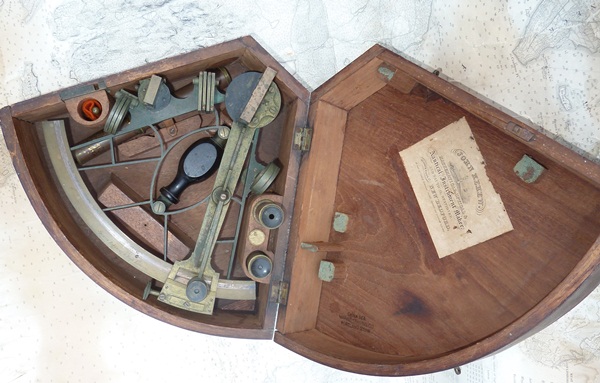 |
SBR SEXTANT
For the discriminating mariner or collector, this fine old instrument is in excellent condition, particularly considering its age. Made about 1840, it was the very best quality available for its time. Made by the famous firm of Spencer Browning & Rust, it incorporates the new style "lozenge and ladder" frame with engraved silver arc, two scopes and a tube. Engraved in the bronze below the silver inlay on the arc is the inscription "Spencer Browning & Rust, Long" in the early 19th century style. The index and horizon mirrors have clouded but this should be expected after all these years.
The sextant is "as found," meaning I only had to blow the dust from the box. It still has the label of John Kehew, a well-known supplier of navigational charts and instruments to the New Bedford whaling fleet.
|
Our Price:
SOLD
E-Mail
Inquiries
Call for
More Info:
207.657.2117
|
|
|
|
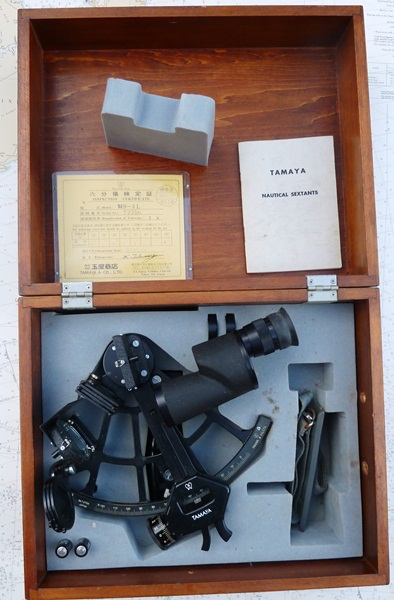 |
TAMAYA SEXTANT
For the ocean mariner, here is a Tamaya MS-3 sextant made in 1978. This is the model with the light unit to illuminate the vernier scale. It comes with a 7 x 35 monocular, extra bulbs, filters, wrench and carry strap so you don't lose it over the side. The box is missing its lock, probably removed for cleaning and misplaced. This is a well-balanced, light alloy frame sextant, weighing under 3 KG. Tried and true, the Tamaya has been proven on all the oceans of the world. (1000-3)
|
Our Price:
$500.00
E-Mail
Inquiries
Call for
More Info:
207.657.2117
|
|
|
|
|
|
|
|
|
|

|
|
At China Sea Marine Trading our focus is Nautical Antiques, Tools & Traditions. Expect the usual, and the unusual. Explore the categories from bells to binnacles, ship's lights to swords, ship's wheels to ring buoys, net floats to flags to folk art, telescopes to tribal art. Find an ocean liner menu for your collection, a fid for your ditty bag. Chart a course with a compass or choose an artifact from the Great Age of Piracy. And if you don't see what you want, ask for it.
Your inquiries are welcome! |
|
|
|
China Sea Marine Trading Co.
Steve Bunker & Sharon Bondroff
229 Portland Road • Gray, Maine 04039
Phone: 207-657-2117
E-Mail: [email protected]
©2008 China Sea Trading. All rights reserved.
|
|
|
|
|
|
|
|
|
|
|
