 |
|
|
|
|
|
|
|
|
|
|
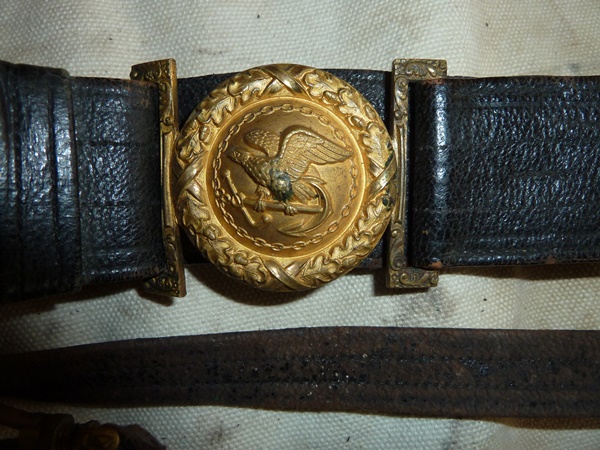 |
NAVAL OR COAST GUARD SWORD BELT
This is a regulation naval officers sword belt from the Spanish American War to World War I period. The eagle and anchor design is a variant from the usual motif and seems to have been a favorite with revenue cutter and coast guard officers though many US Navy officers wore it as well. The belt and sword slings are made of pebble grain leather and show some wear. The brass buckle still retains some of its gilding and is in nice condition. The belt is fairly small in size, probably a 32 to 34; I would not recommend wearing it as it is 100 years old. A great display piece with your naval officers sword.
|
Our Price:
SOLD
E-Mail
Inquiries
Call for
More Info:
207.657.2117
|
|
|
|
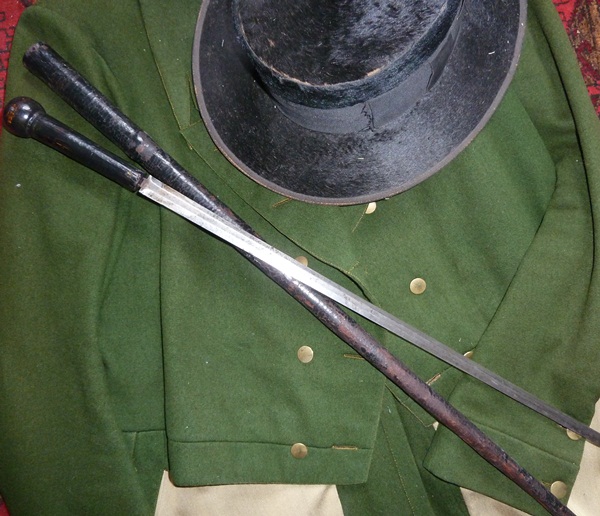 |
EARLY SWORD CANE
If you were prowling the East End docks of London or the Barbary Coast of San Francisco in the 19th century, you needed one of these. It is a classic old sword cane carried by sea captains and gentlemen when ashore searching for crews or exploring the seedier parts of a port of call.
This cane--or walking stick--is 35 inches along. It was made by rolling a thin sheetiron tapered tube around a wood shaft. The cane was then covered with leather and japaned, or painted black. This mades for a very solid cane. The surprise is a full-length, double-edged sword blade concealed within. A pull of the knob cap produces a 19-inch blade ready for serious business.
I would estimate it to be at least 175 years old. The sword blade is what was referred to as a "small sword," a type of weapon carried by gentlemen and officers in the 18th and early 19th century. This one has no markings.
It is being sold as an antique. If you get in trouble on the waterfront or in a bordello, I don't want to know about it. (12183)
|
Our Price:
SOLD
E-Mail
Inquiries
Call for
More Info:
207.657.2117
|
|
|
|
 |
US NAVY CUTLASS
The Model 1860 naval cutlass was adopted just in time for the Civil War. It is probably the most popular American naval weapon with collectors. It was used as a model for the illustrations of pirates by generations of artists though of course it was incorrect. Nevertheless, it is still thought of as the classic sailors cutlass.
Here is an excellent, early example. It was made by Ames Manufacturing of Chicopee, Massachusetts and is dated 1861. It has a 26-inch (66 cm) blade and is 32 inches (82 cm) long, including the grip. It has seen naval service and is marked with its rack numbers on the brass guard. The blade has been sharpened in the past and is a silver gray in color with a few darker spots though no rust. The pommel and guard are unshined brass. The basket of the hilt has a few small dents but is completely intact. The leather and wire on the grip is gone but the wood is strong and complete. As is usual with these cutlasses, the scabbard is gone. This is a good, typical example of this weapon and it is nice to have the early date.
|
Our Price:
$700.00
E-Mail
Inquiries
Call for
More Info:
207.657.2117
|
|
|
|
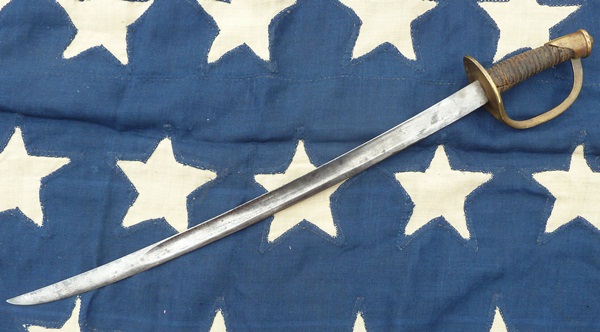 |
1860 US NAVY CUTLASS VARIANT
The model 1860 cutlass is probably the most popular naval sword prized by collectors. Here is an unusual variation of the Civil War Navy sidearm.
The 1860 cutlass was manufactured by Ames in Chicopee, Mass as well as other companies. It was made between 1860 and 1865, originally designed with a cup hilt as protection for the hand in combat. At some point during this era, a few of these weapons were altered to have a simple "D" guard. I have never found a regulation for this but, from photographic evidence we know this was done while in naval use.
This particular weapon is well-marked "USN D.P. 1864" on the ricasso of the blade. Faint partial markings for Ames and Chicopee can be seen on the reverse side. It has an inspectors mark "DR" on the pommel. The blade has very light pitting on one side though it is clean on the other. It shows evidence of sharpening at one time. The wood grip has a small crack; most of its leather wrap is in place but worn. The wire wrap has been removed. The sword is 31.5 inches long with a 25-inch blade.
|
Our Price:
$645.00
E-Mail
Inquiries
Call for
More Info:
207.657.2117
|
|
|
|
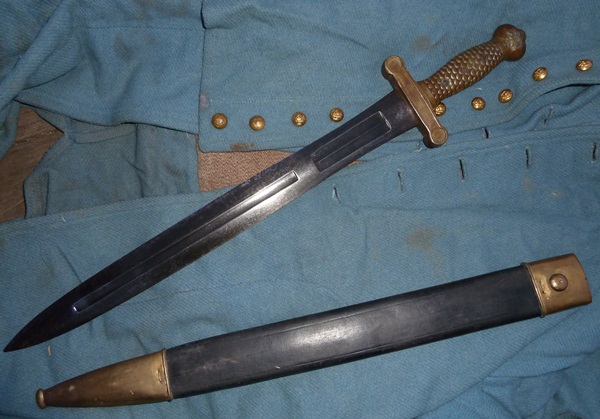 |
ARTILLERY SHORT SWORD
Based on a French Napoleanic idea of an ancient Roman sword, this is the US army foot artillery sword pattern of 1833. A direct copy of the French sword, these were produced by Ames in Massachusetts from the 1830s through the Civil War. Soldiers despised them, considering them as a useless encumberance and often discarded them in field service, but heavy artillery units and coastal fortifications used them into the 1870s.
When naval ships found themselves short of cutlasses they were often given these army foot artillery swords. They are somewhat similar to the US Navy 1841 cutlass. This was particularly true for the "brown water navy" on the western rivers in 1862 to 1865. Several of these swords were found on the wreck of the U.S.S. Cairo when it was raised in 1963.
This sword was found here in Maine, perhaps brought home by a member of the famous 1st Maine heavy artillery or a Civil War sailor. It is well marked by Ames and dated 1850. It bears the inspectors marks of "GGS" and in fine stamped script, "WAT." The 19-inch (48 cm) blade has a lightly mottled finish with a few patches of oild light rust which I have oiled. You may choose to restore the blade further though I like its antique finish. The grip, guard and pommel are brass. I have not shined or cleaned them.
The original scabbard was missing when I acquired this sword. I am supplying a correct scabbard that I found in among my sword parts. It is correct though I doubt it is 150 years old. Still, it will protect the blade. Impracticle as it is, it has a haunting beauty as a surviver of our early military and maritime past.
|
Our Price:
SOLD
E-Mail
Inquiries
Call for
More Info:
207.657.2117
|
|
|
|
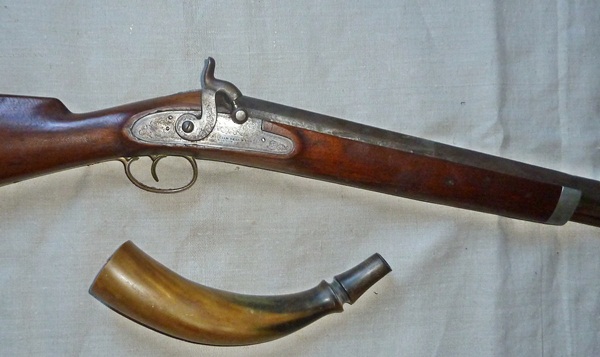 |
CLASSIC NEW ENGLAND FOWLER
It would be hard to find a nicer example of the classic, New England fowling piece of the mid-19th century. This is a 10 ga., smooth bore with a 44-inch barrel. The gun measures almost 60 inches long from buttplate to muzzle. The engraved lockplate reads "William Read & Son, Boston," The large flat hammer is nicely engraved. The buttplate and trigger guard are in brass. The stock is very plain as in most field guns. Aside from minor scratches it is very sound with no cracks or repairs. The original ramrod is gone, as is usual with these old field guns, so I made a replacement from black walnut with a horn tip.
Some family enjoyed many a goose dinner, thanks to this fine old firearm. It would look nice over the fireplace in a traditional home. I'm including an old, original hunting horn. It was used to call the hunting dogs from the field. (900-2)
|
Our Price:
SOLD
E-Mail
Inquiries
Call for
More Info:
207.657.2117
|
|
|
|
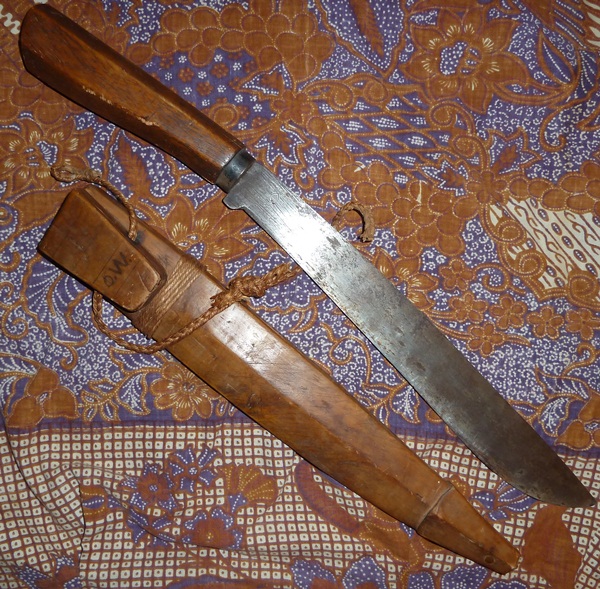 |
BARONG
This traditional short sword is usually called a barong or a parang. It is used as a tool and, when necessary, a weapon. They are found throughout the islands of Southeast Asia, the Celeebs and the Phlippine sea. This example is probably Philippine and likely about 75 years old. It has a heavy, 13.5 inch blade that is .25 inch thick. The knife is 22 inches long in the wood scabbard. These were well-regarded weapons among the Moros and pirates of the Southern Islands. This one is still in excellent shape and could clear a jungle trail or end the career of a Japanese soldier at a moment's notice.
|
Our Price:
$95.00
E-Mail
Inquiries
Call for
More Info:
207.657.2117
|
|
|
|
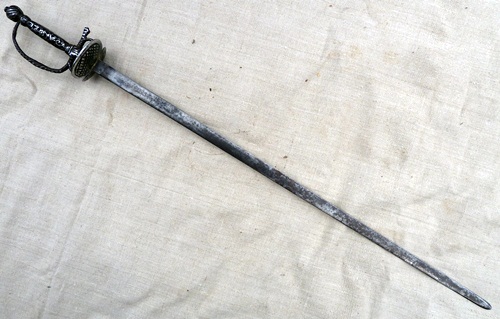 |
18TH CENTURY CHILD'S SWORD
A late 18th century child's sword in the style of a gentleman's small sword of 1750, found in an attic in Maine. It features an iron guard and grip with a steel, 22-inch unsharpened blade. The iron grip has an interesting pierced motif.
Childrens' swords are usually found in terrible condition. This one has survived its 200-plus year history very well. Aside from a little cleaning and restoration, the sword is in excellent condition with no looseness or obvious damage.
|
Our Price:
SOLD
E-Mail
Inquiries
Call for
More Info:
207.657.2117
|
|
|
|
 |
CHINESE BOARDING PIKE
In the great era of Chinese piracy and the Opium Wars of the early to mid 1800s, modern weaponry was difficult to acquire for the lower level warrior on the southeast Asian coast. Local ironsmiths filled the weapons gap with thousands of pikes. They have been used for centuries at sea by Asian, European and American navies and by privateers for repelling boarders. Coastal militias used them to arm their garrisons defending villages and towns.
Here is one example recently found in a small hoard uncovered in China. It is hand-wrought iron with an interesting brass or bronze ferrule at the base of the blade. The blade measures 10.5 inches in length. I have left the piece in "as found" condition but you can easily clean it with steel wool and oil. Give it a light buff with a little car wax and the remaining rust will darken and mellow to a deep patina. Mount it on a short or long shaft for an impressive display.
A gentle warning: These are being foisted off on unsuspecting collectors on the internet and at gun shows as American Revolutionary War pikes. Don't be fooled. They are 100 percent Chinese antique pike heads.
|
Our Price:
SOLD
E-Mail
Inquiries
Call for
More Info:
207.657.2117
|
|
|
|
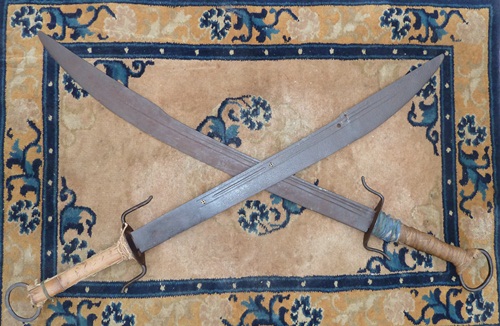 |
PAIR OF CHINESE SWORDS
This is an unusual pair or, more correctly, a set of two traditional Chinese swords. Probably from the same sword workshop, these are identical in style, with one being slightly more ornate. Boh measure 34 inches with 25-inch blades. The blades are entirely hand-wrought of tempered crude steel or slightly refined iron. The long grips are of bamboo and ancient paper fragments over the integel forged tang. These grips were originally covered with colored, braided or wrapped cloth, the color usually indicating rank or group. Some cloth still remains on the plainer sword.
The more ornate blade shows very fine engraved Chinese characters and a couple of tiny brass inlays. Both blades show the small forge marks, cracks and imperfections of most ancient Chinese blades. I have left them in an unrestored state. But a little oil and wax will make them shine.
I believe they date from the late 18th century to the Taiping Rebellion of the 1850s. They would make a dramatic wall display.
|
Our Price:
$550.00
E-Mail
Inquiries
Call for
More Info:
207.657.2117
|
|
|
|
|
|
|
|
|
|

|
|
At China Sea Marine Trading our focus is Nautical Antiques, Tools & Traditions. Expect the usual, and the unusual. Explore the categories from bells to binnacles, ship's lights to swords, ship's wheels to ring buoys, net floats to flags to folk art, telescopes to tribal art. Find an ocean liner menu for your collection, a fid for your ditty bag. Chart a course with a compass or choose an artifact from the Great Age of Piracy. And if you don't see what you want, ask for it.
Your inquiries are welcome! |
|
|
|
China Sea Marine Trading Co.
Steve Bunker & Sharon Bondroff
229 Portland Road • Gray, Maine 04039
Phone: 207-657-2117
E-Mail: [email protected]
©2008 China Sea Trading. All rights reserved.
|
|
|
|
|
|
|
|
|
|
|
